Peptide Quality: Relevance Of Third-party Validation
During solid-phase synthesis, each amino acid combining step has a return of Have a peek at this website roughly 99-- 99.8%. When a coupling stops working, the expanding chain is capped to stop more prolongation of the inaccurate sequence. The result is a peptide that's shorter than intended-- missing several amino acids.In vivo tests examine absorption, distribution, metabolism, and excretion (ADME) characteristics, better validating efficacy and security. These screening services not just aid clients enhance items precisely during development however also offer solid data support for regulatory compliance of peptide formulations. Beware of COAs that supply a pureness number without any sustaining chromatographic data, record pureness without specifying the analytical approach, or list a molecular weight without mass spectrometry confirmation. Tandem mass spectrometry (MS/MS or MS ²) fragments the peptide ions in the gas stage and evaluations the fragment masses. This is the gold criterion for peptide identification-- it verifies both the structure and the sequence. For many peptide tasks, outright peptide amount matters as long as chromatographic purity.
In addition to HPLC and MS, specialized labs might employ orthogonal methods for added accuracy. For instance, capillary electrophoresis can be made use of to separate extremely hydrophilic peptides or to verify results, and MALDI-TOF mass spectrometry can assist in mapping bigger or customized peptides. Several peptide producers or providers will certainly supply a COA (Certification of Analysis), as an example our bpc 157 tb 500 blend, that includes the pureness percentage by HPLC and identity verification by MS for each and every batch. Top-tier labs usually report peptide purity well over 95%, regularly ≥ 98-99%, by utilizing state-of-the-art HPLC and MS analyses. They also check both resources and finished peptide vials, which assists capture any kind of impurities, destruction products, or formula incongruities.
Just How To Review An Hplc Chromatogram
It is one reason appropriate peptide storage space and reconstitution techniques matter. Partial peptide fragments can arise from incomplete synthesis or post-synthesis degradation. These fragments are usually smaller than the target peptide and might elute at different retention times.What The Contaminations Really Are
It's possible to have a peptide that is, say, 95% pure by HPLC and yet the internet peptide content is something like 70% of the powder's weight (the remainder being water and salts). Do not be distressed-- this is normal and is typically figured out by separate analyses (like amino acid evaluation). Peptide purity is most typically figured out by high-performance liquid Human Performance Research chromatography (HPLC) with a discovery wavelength of 220 nm, which is ideal for detecting peptide bonds. This approach separates peptides from pollutants and measures both target peptides and pollutants, ensuring premium samples for study.Other strategies like electrophoresis, capillary electrophoresis (CE), and nuclear magnetic vibration (NMR) can also be made use of to assess peptide structure, fee, and pureness, guaranteeing detailed characterization. In COA evaluation, it typically includes HPLC purity screening, mass spectrometry identification confirmation, and batch-specific documentation showing the evaluated whole lot, approach, results, and day. For peptide pureness screening, reverse-phase HPLC is the basic conceptual version. The chromatographic pureness is after that computed by contrasting the location under the major height with the total location under all integrated optimals.

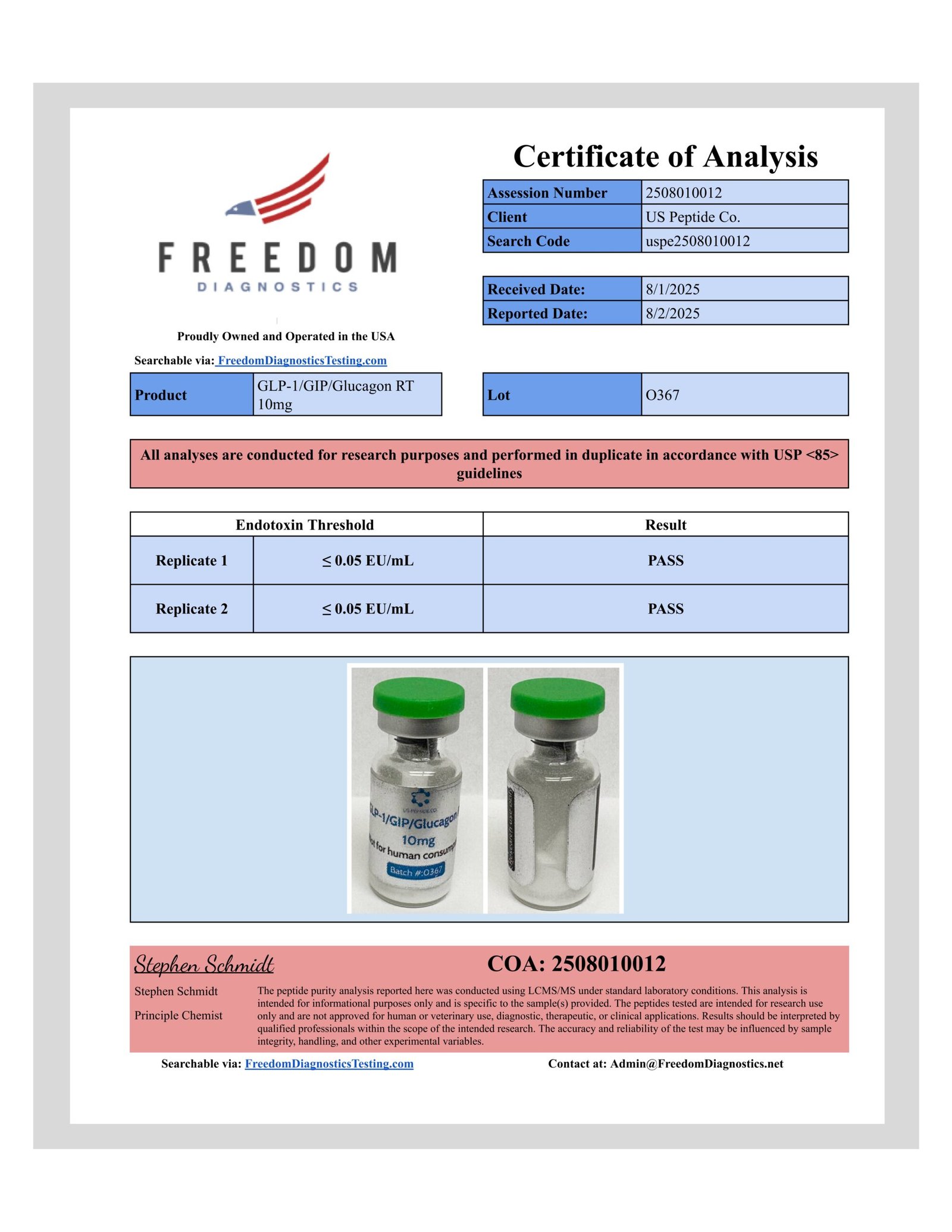
- Alternatively, making use of peptides that have actually passed third-party lab validation helps make certain that the observed experimental impacts are absolutely due to the desired peptide and not because of pollutants or mistakes.These numbers obtain sprayed so often that it's easy to gloss over them-- simply one more specification on a product web page.HPLC-tested suggests the sample was run through high-performance fluid chromatography to separate the target peptide from pollutants.As the percent of natural solvent slowly boosts throughout the run, particles are released from the column in order of their hydrophobicity-- the more hydrophobic a peptide, the longer it takes to elute (clean off).